Tag Archives: Contemporary art

The Gallery as a Dance Hall

27 Apr

It has been a while since the last article, however this is due to a lack of cohesion within the contemporary art world recently, but now a clear trend has appeared for visual artists making works that transform the gallery space into a site for dance and performance.  With Arts Council England redistributing funding from its new National Portfolio in favour of dance, and programmes such as Strictly Come Dancing and So You Think You Can Dance? gracing our television screens, it is likely that interest in dance is growing, and hence galleries are making curatorial decisions in favour of this kind of cross-genre art form.

It is not new for artists to engage in set design with a president set by Piet Mondrian, who designed a set for Michel Seuphor‘s L ‘Ephémère est éternel, and Liubov Popova (who was exhibited with Alexander Rodchenko at Tate Modern in 2009).

What is perhaps different is that many of these contemporary artists (and similarly video artists such as Nathaniel Mellors, showing at the ICA) are controlling the whole experience in the fashion of Richard Wagner.  In German there is the word Gesamtkunstwerk that describes this all-encompassing art form.  However it is likely many of these contemporary artists are working on a much smaller budget.

Continue reading

Constructing Photography Now

14 Feb

Chu YinHua‘s slides on exhibition at The Mews Project Space provide an interesting critique of the built environment and the way the artist feels nomadic, without a home base, which is perhaps in essence critical of a negative impact upon artists caused by immigration laws.  Presented on a small-scale in a row of slide viewers, it is difficult to gage reality.  We see out of windows from a series of rooms with a very retro style of wallpaper, 1950s perhaps.

It is only by creating a miniature room which she can carry around with her, that Chu is able to feel at home anywhere.  In essence this is alike the boxes Georgian servants had as their only private space (mentioned by Amanda Vickers in BBC series At Home with the Georgians).

Whilst the rooms in Chu’s work are miniature, the views are real and include Nelson’s Column in Trafalgar Square and locations around South London in which Chu feels she would be happy to live.  They too are mediated however, through being images on a laptop screen behind the model, some at least extracted from Google Street View.  Such mediation allows us to now digitally travel to anywhere of our choosing simply at the click of a mouse.  Hence Chu chooses to make her home a virtual place.  She could have a party on social networking and chat room websites and even offer someone a slice of cake and a cup of tea.  The freedoms of consuming digital travel, however, might be said to lead us to exist in a box and never leave it.  Well, we can work from home, order in groceries and takeaway, or even go for a stroll around one of the world’s major art museums with the latest Google project.

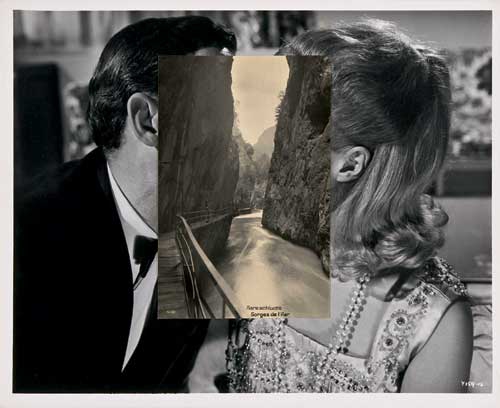
Pair IV (2007) by John Stezaker, Collage, Private Collection, © The Artist

Nearby at the Whitechapel Gallery a retrospective of John Stezaker‘s work demonstrates a similar yet different kind of photographic construction.  Where Chu constructs the subject scene of her images, Stezaker constructs his images by physically collaging prints of found images, film stills and landscape postcards to create humourous and provocative works.

Continue reading

Drawing in space

5 Feb

Bridget Riley‘s Composition with Circles 7 (2010), installed at the National Gallery, London, makes use of circles in a similar manner to Susan Hiller‘s Magic Lantern discussed in my previous article ‘Curated to Confuse?‘.  Riley and her assistants have drawn a series of meticulously accurate, large, monochromatic circles across the entirety of a vast gallery wall.  Like Hiller’s projection, they build up layers, overlapping and forming a series of Venn diagrams.  However, where Hiller explores colour, Riley explores ways of tesselating the circles, creating a vast array of different size and shape sections of overlap and space, whilst maintaining a fairly ordered overall plane.

Adrian Searle furthers the link between the two by saying this work of Riley’s “… seems to envelop you as if one were consumed by bubbles of light.” (http://www.guardian.co.uk/artanddesign/video/2010/dec/15/bridget-riley-national-gallery-wall-circles).  However this work feels much more rigid and defined than flowing light.

This is an installation of drawing which looms over the viewer, affecting our perception of space.  It also physically alters the gallery walls in a museum that, due to its collection, usually retains works within a frame.  Hence it is an intervention in the space, much like Doris Salcedo‘s Shibboleth (2007), a crack in the floor of Tate Modern‘s Turbine Hall.

Besides this piece, it is a small exhibition and predominantly represent’s Riley’s current work, not necessarily her most interesting.  On the other hand it is interesting to see how her modern abstract style has been inspired by some more traditional sources.  A couple of Riley’s older Op Art style works are included, and these create the optical illusion of three dimensionality.  The exhibition Common Logic at IMT Gallery, however, exhibits a series of experiments which take drawing literally into three-dimensional space.

Continue reading

Curated to Confuse?

24 Jan

Simon Starling’s exhibition at Camden Arts Centre is one of a curatorial nature, yet is diverse and unpredictable.  The theme behind the exhibition is to bring together work exhibited over the gallery’s thirty year history.  Modernist chairs sit on plinths alongside a Francis Bacon and Graham Gussin’s Fall (7200–1) (1998), which combines a computer randomly generating a continual stream of zeros it appears that apparently affect the footage of a waterside location projected opposite.  In the next room Jacques Monory’s 1973 painting of a picnic labeled as including Christian Boltanski and himself taken from a 1970 photograph.  Opposite this is Christian Boltanski‘s 1971 photograph Essai de Reconstitution d’un tableau de Jacques Monory, a photograph recreating the gathering depicted in the original image.

An exhibition of Susan Hiller‘s work opens shortly at Tate Britain but her 1987 slide projection entitled Magic Lantern is currently on display within this exhibition at Camden Arts Centre.  Not being a familiar artist, however, it appears Hiller has worked in many media and I await the forthcoming exhibition to gain more insight into her practice.  Magic Lantern, is a little slow showing just 12 slides from each of the three slide projects over a 13 minute show.  However the slides are combined with an audio track based on the sound experiments of a Dr Raudive.  This is a mixture of relaxing female voices chanting, as might perhaps be heard in a mosque, with messages with background noise that sound like old wireless recordings, which builds with the slide projection to create a trance like or hypnotic sensation.

The slides themselves are very simple, each one contains a circle of pure colour, almost entirely the three primary colours.  However Hiller’s combination of these creates a multicoloured light show.  The three coloured circles are blended into one another in a kind of Venn diagram, faded in at constantly varying levels of intensity, hence blending coloured light like blending hues of pigment.  In essence you could relate it to the scientific experiments with light; A level physics experiments with lasers and diffraction gratings spring to mind although that isn’t what this is.  Dust and hairs collecting on the slides add to the work, giving it grain and texture that appears to protrude from the projection wall and further draw you into the hypnotic depth of the colour.

Continue reading

New Contemporaries

16 Jan

Bloomberg New Contemporaries 2010, at the ICA this year, is a large group exhibition of new art talent; recent graduates.  Hence it is a pretty diverse exhibition and hence feels much like an art school show.  The layout of the ICA galleries furthers this feel of fitting into particular spaces within an institution.  There are however some interesting pieces in the exhibition which suggest a discourse of emptiness, of something lacking perhaps, whilst on the other hand being an exploration of contrasting textures. 

Nick Bailey’s Safe seems rather dumb, a mute casket to which we are not provided access.  We might wonder what could be inside it, but particularly when seen alongside Dials Slightly to the Right, it seems the form itself is the focus of this work; a solid, black box protruding from the wall.  Perhaps it brings Kasimir Malevich‘s studies into a three dimensional form.

Matthew Coombes’ Site Receiver: Untitiled (2009) makes clever use of simple materials; smooth hardboard cut at asymmetric angles contrasted with the texture of anti-climb paint.  This creates a void in the wall somewhat like an Anish Kapoor piece exhibited in the last British Art Show at the Hayward Gallery.  It also seems like it would absorb sound like an open mouth, either rendering it dead or perhaps creating absurd refracted echos, whilst the walls of the nearby screening rooms have been hung with things that look like box canvases to absorb sound that could be similar works.

Continue reading

2011, The Year Ahead

1 Jan

Happy New Year!

At this time of year it seems appropriate to take a look at some highlight exhibitions programmed for the year ahead.

  • Riflemaker kick off 2011 with an exhibition entitled Analog paying homage to all things analogue, particularly featuring Richard Nicholson’s series of photographs of darkrooms at the point of their demise.
  • Daniel Sinsel is not an artist I have come across before but his upcoming exhibition from the end of January at Chisenhale Gallery sounds interesting.  “Sinsel’s small handcrafted paintings and sculptures explore classical themes of space, volume and illusion and combine art historical references with a personal iconography.”

Still (expanded post)

20 Dec

I enjoyed Roelof Bakker‘s exhibition ‘Still’ at Hornsey Town Hall in November, although I personally feel this series is too dispersed or diverse and needs further editing into a smaller group or groups.  The images that were of most interest are the few of the large spaces devoid of life such as The Green Room below, The Council Chamber and The Stage (Piano), along with those of stacks of ancient scrolls or plans, creating a honeycomb of history, each numbered with a luggage tag.

Most haunting, however, was the video, which was under-promoted.  This included scenes from many more interesting parts of the building than are included in the images exhibited.  We appear to have stepped into a 1930s that has been abandoned.  It’s as if a major event has devoid the place of life.  Perhaps we lost the second world war.  Or else something along the lines of the early plot of 28 Days Later has occurred.  The space is ready for use but there is no life here.

Many of the spaces we see seem of a peculiar antiquation that is beyond twenty-first or late twentieth century business use yet not like anywhere I have seen conserved as a museum.  I can only guess anywhere equivalent has already fallen into disuse and been demolished.  The spaces are abandoned, yet feel too fresh, crisp, new and little used, as if we have travelled back in time. 

Continue reading

fotolog/

5 Sep
IMT’s latest exhibition is a positive departure from their specialism in predominantly sound based art forms.  Alejandro Ospina’s paintings form an installation, drawing allusion to the ordered grid patterns of many websites ranging from search engine images, social networking and dating websites, through to those of glamour magazines or of a more overtly sexual or pornographic nature.  The fifteen paintings hung around the gallery’s convex wall in a five by three grid formation also remind me of the video ‘quadrasphere’ exhibit on the water cycle at the Natural History Museum, where a similar grid of TV screens are surrounded by mirrors on all sides to create the visual effect of a whole globe of radiating light and image, much like the glowing computer screen these images originate from.